Austin's Shifting Business Geography: Where Companies Are Actually Landing
The Austin business map looks different than it did five years ago. Downtown is still important, but the real action has moved north, and the companies arriving in waves are making calculated bets on corridors most local guides barely mention.
The Map Has Moved
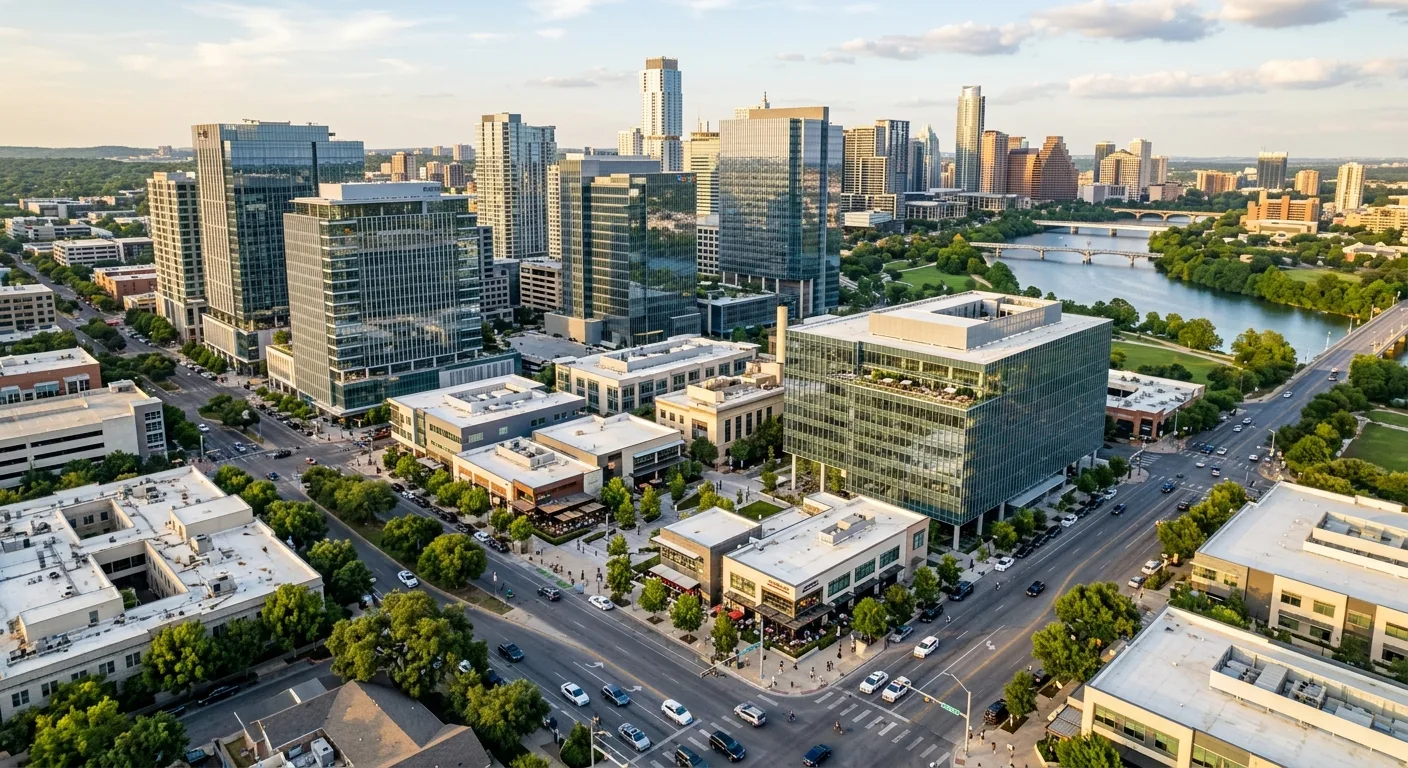
Pull up a map of Austin’s commercial real estate and you’ll notice something that surprises a lot of people relocating from coastal markets: the densest concentration of office inventory isn’t downtown. It’s a six-mile corridor stretching north from the Arboretum up through the Domain toward Tech Ridge, and it’s been swallowing corporate tenants at a pace that caught even longtime Austin brokers off guard.
The shift started around 2019, accelerated through the pandemic relocations, and has now settled into something more permanent. Downtown Austin still draws attention, especially for headquarters announcements and the kind of trophy addresses that matter for recruiting announcements. But the day-to-day decisions, the ones made by operations teams weighing commute times against lease rates against parking, have been consistently pointing north and northwest.
Understanding why that happened explains a lot about how Austin actually works as a business address.
The North Corridor: What Drove It
The Domain was originally a retail play. Endeavor Real Estate Group started building it out in the mid-2000s as a mixed-use lifestyle center anchored by upscale shopping. What they ended up with, almost by accident, was one of the most functional suburban office ecosystems in any major American city.
The key ingredient wasn’t the office buildings themselves. It was the residential density that built up around them. Young professionals who moved to Austin between 2015 and 2022 chose apartments in North Austin at rates that made Midtown Manhattan look slow. By 2023, the Domain ZIP code had enough residents within a 20-minute drive to support a serious talent pool, and tech employers noticed.
Companies that set up offices at the Domain, among them indeed, Oracle’s Austin operations, and a rotating cast of midsize tech companies, found that recruiting worked differently there than it did downtown. The people they were trying to hire already lived nearby. The commute math worked without asking anyone to sit on I-35.
That logic has since spread east to the 183-Tech Ridge corridor, where older Class B and C inventory has been renovated and retenanted by companies that need functional space at rates below what the Domain commands. It’s also spread north into Cedar Park and Round Rock, where companies with larger floorplate requirements and lower rent tolerance have been signing deals on suburban campuses that would have been considered too far from the action a decade ago.
What Downtown Actually Offers
Downtown Austin’s commercial case rests on a few things that the north corridor can’t replicate. The first is visibility. An address on Congress Avenue or in the Second Street District still carries a symbolic weight that matters for certain kinds of business. Law firms, financial services companies, and public-facing professional services operations read different to clients when the building is downtown.
The second is walkability. Downtown Austin, specifically the stretch from Rainey Street up through the Warehouse District to the Sixth Street corridor, has genuine walk scores and an after-work culture that suburban campuses can’t fake. For companies with employees who don’t own cars, or who prioritize the social texture of their work environment, downtown remains the right answer.
The third is access to UT Austin. The university sits at the northern edge of downtown, and companies that run active recruiting pipelines through UT’s engineering, business, and computer science programs find that proximity matters for events, internships, and faculty relationships. Several research-oriented companies have specifically cited UT access as a reason for downtown or near-campus locations.
The honest tradeoff is cost and parking. Downtown Austin office rents have stabilized after the post-pandemic correction, but they’re still running $10 to $15 per square foot higher annually than comparable Class A space at the Domain or along 183. Parking, either on-site or structured garage access, adds meaningful cost per employee on top of that. For companies calculating total real estate cost per headcount, the north corridor usually wins on the spreadsheet.
The Suburbs Make a Real Case
What changed the calculus for suburban Austin wasn’t the suburbs themselves, it was who started living there. The city’s growth pushed residential development north and northwest faster than infrastructure could follow, which meant that by the early 2020s, significant concentrations of professional workers were already living in Cedar Park, Leander, Round Rock, and Pflugerville.
A company that opens an office in the Domain or on the 183 corridor isn’t choosing a suburban backwater. It’s positioning itself in the middle of where its workforce lives, and avoiding the daily grind of the MoPac and I-35 interchange that makes downtown commutes genuinely punishing during rush hour.
Round Rock in particular has built a real commercial base anchored by Dell’s campus and the downstream supplier and services ecosystem it created. The Round Rock market now supports Class A spec space that would have been unthinkable there fifteen years ago. Companies that need 50,000 to 150,000 square feet have found Round Rock to be one of the few Austin submarkets where that kind of contiguous footprint is actually available.
What to Watch in the Next Two Years
Several things are moving simultaneously in Austin’s commercial market that matter for anyone making location decisions now.
The rideshare and transit infrastructure serving North Austin has improved enough to change commute math for workers without cars. CapMetro’s MetroRail line connects downtown to the Domain area, and the Pickup on-demand service has filled in enough gaps that car-free employees aren’t as automatically excluded from north Austin offices as they once were.
The South Austin market, specifically the area around South Congress and St. Elmo, has generated genuine commercial interest for the first time in years. Several creative-industry and media companies have clustered there partly for the neighborhood identity and partly because the East Riverside corridor has depressed some lease rates below what you’d expect given the proximity to downtown.
And the eastern crescent, running from Mueller through Austin’s Eastside, is getting a second look from tech companies that want downtown access without downtown prices, and who want to be in a neighborhood that reflects Austin’s cultural texture rather than a corporate campus carved out of former farmland.
The map keeps moving. The companies that read it accurately tend to come out ahead on lease terms, talent access, and the quieter variable that never shows up on real estate pro formas: whether the people they hire actually want to show up.
Office inventory and rent figures referenced here reflect broker market surveys from late 2025 and early 2026. Specific lease rates vary significantly by building class, term, and tenant improvement allowances.